
Europe Automotive Powertrain Market Size & Forecast:
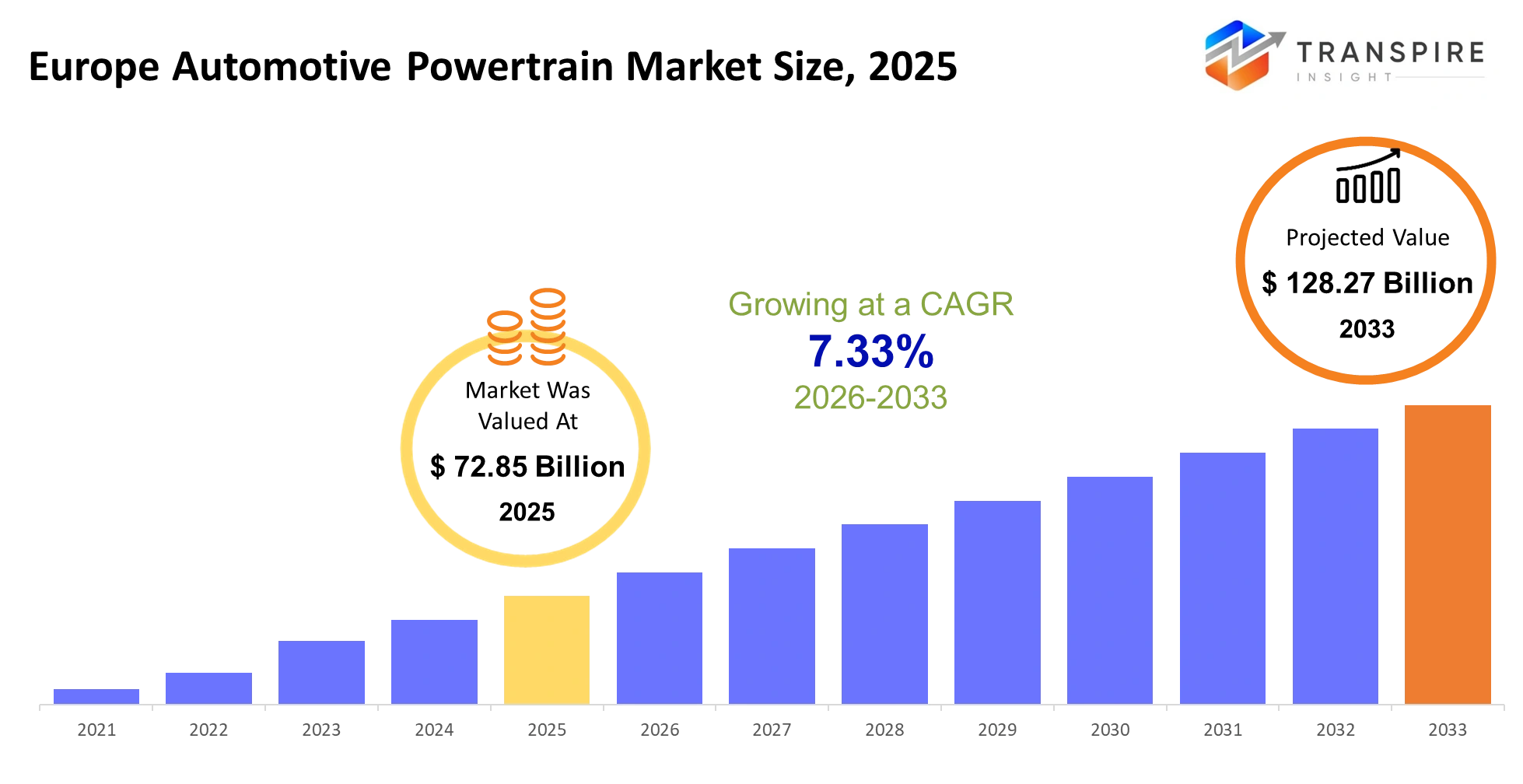
- Europe Automotive Powertrain Market Size 2025: USD 72.85 Billion
- Europe Automotive Powertrain Market Size 2033: USD 128.27 Billion
- Europe Automotive Powertrain Market CAGR: 7.33%
- Europe Automotive Powertrain Market Segments: By Type (ICE Powertrain, Electric Powertrain, Hybrid Powertrain, Hydrogen Powertrain, Others); By Application (Passenger Vehicles, Commercial Vehicles, Electric Vehicles, Hybrid Vehicles, Others); By End-User (OEMs, Aftermarket, Fleet Operators, Mobility Providers, Others); By Component (Engine, Transmission, Drivetrain, Battery Systems, Others).
To learn more about this report,  Download Free Sample Report
Europe Automotive Powertrain Market Summary
The Europe Automotive Powertrain Market was valued at USD 72.85 Billion in 2025. It is forecast to reach USD 128.27 Billion by 2033. That is a CAGR of 7.33% over the period.
The Europe Automotive Powertrain Market focuses on vehicle energy conversion through its engine systems and electric motor systems and hybrid systems and integrated drivetrain components. The system enables automakers to achieve three goals by balancing their performance and emissions compliance and fuel efficiency requirements with the existing European mobility regulations. The market has moved away from combustion-based engineering practices during the past three to five years because engineers now use electrified and software-controlled propulsion systems which include e-axles and power electronics and battery-based platforms to design vehicle systems.
A fundamental transformation occurred when OEMs reorganized their product lines to support electrification-first platforms after the European Union established its permanent carbon dioxide reduction targets and announced its 2035 ban on internal combustion engines. The 2021-2023 semiconductor shortage created supply chain disruptions that forced manufacturers to modify their powertrain sourcing methods while increasing their use of modular drivetrain systems. The automotive market now achieves revenue growth through high-value electrified components which automotive powertrain suppliers focus on developing while they build scalable hybrid systems and EV-ready platforms to obtain long-term contracts which help them manage profitability throughout the European automotive powertrain market.
Key Market Insights
- Germany protects its market dominance through its OEM base which supports higher electrical system development, which enables the nation to achieve a 30% market share in 2025.
- Poland and Hungary together create the fastest developing area in Eastern Europe, which lasts from 2024 until 2030, because both countries become new centers for electric vehicle components and supplier production.
- The worldwide market for hybrid powertrain systems reaches its highest point in 2025 when the systems achieve a 40% market share because the industry shifts towards electric vehicle technology from internal combustion engine technology.
- The automotive industry in Europe holds its second largest share for internal combustion engine systems because existing vehicle fleets continue to drive demand, while the industry reduces its investment spending.
- The e-axle and integrated drivetrain systems experience their highest market expansion between 2025 and 2032 because their compact designs enable more efficient operations.
- Passenger cars dominate applications, contributing about 70% share due to high EV adoption and urban mobility electrification trends.
- Commercial vehicle electrification accelerates rapidly as logistics operators adopt hybrid drivetrains to meet EU urban emission restrictions by 2027.
- The original equipment manufacturers (OEM) serve as the main end-user group because they handle design work for platforms while gaining benefits from software-based vehicle technology and electric powertrain systems.
- Fleet operators along with aftermarket analytics companies experience fast growth because they use predictive maintenance systems to decrease both equipment downtime and operational expenses.
- These companies expand their operations through their battery partnerships and the development of silicon carbide inverters and their new manufacturing facilities throughout Central and Eastern Europe.
What are the Key Drivers, Restraints, and Opportunities in the Europe Automotive Powertrain Market?
The European automotive powertrain market experiences its strongest growth because Euro 7 emissions standards and the EU 2035 combustion vehicle phaseout plan create more stringent environmental regulations. The automotive industry needed to develop hybrid and battery-electric vehicle systems at an accelerated pace following 2022 because these regulations required them to do so especially in Germany and France and Nordic countries. Volkswagen AG and Mercedes-Benz Group AG dedicated more resources to developing electric vehicle platforms and software-based driving systems and domestic battery production facilities to protect themselves from regulatory fines. The market demand for e-axles and battery management systems and power electronics surged which enabled suppliers to develop new income sources by moving away from conventional internal combustion engine parts.
The European market faces its most significant obstacle because it lacks adequate battery production capacity which serves as its fundamental market barrier. The region still depends heavily on imported lithium processing, rare earth materials, and Asian cell manufacturing capacity. The construction of gigafactories and upstream refining facilities needs investment of multiple billion euros and requires lengthy periods for regulatory approvals which creates challenges for immediate market adjustments. The company relies on external sources to obtain raw materials which causes higher production expenses and results in delayed electric vehicle introduction during times when material prices fluctuate. Smaller Tier-1 suppliers experience financial difficulties because they need to support existing combustion engine systems while they pay for their electric vehicle development efforts.
The development of next-generation hybrid systems and range-extender technologies presents a significant growth prospect for businesses. European consumers increasingly prefer hybrid systems that enable them to drive without needing to recharge while meeting new emissions standards.Companies have extended their hybrid-focused joint ventures through Renault Group and Geely Holding Group. Meanwhile Eastern Europe has developed into a manufacturing center that produces cost-effective electrified powertrain components.
What Has the Impact of Artificial Intelligence Been on the Europe Automotive Powertrain Market?
The automotive powertrain industry in Europe benefits from artificial intelligence and digital technology advancements which enhance production accuracy and emission control and vehicle performance evaluation. The Robert Bosch GmbH and ZF Friedrichshafen AG automotive manufacturers now implement AI-based control systems which handle battery management and inverter calibration and thermal monitoring for hybrid and electric vehicle power systems. The system continuously performs sensor data analysis to achieve real-time improvements in torque delivery and energy use and charging performance. Fleet operators now depend on machine learning platforms to monitor vehicle emissions compliance with Euro 7 regulations because these platforms decrease manual reporting tasks while enhancing audit correctness.
Powertrain systems now use predictive maintenance models as their core component. The AI algorithms calculate the vibration patterns and battery degradation rates and motor temperatures to forecast equipment failures before they happen. European original equipment manufacturers (OEMs) achieved measurable improvements in operational efficiency when they incorporated predictive analytics into their connected vehicle systems. Digital twins and simulation software enable manufacturers to enhance fuel efficiency evaluation processes and reduce the time needed for prototype development. The high costs of AI system integration together with the lack of reliable driving data blocks many small suppliers from using AI technology because they still maintain traditional internal combustion engine production methods.
Key Market Trends
- Automakers in the European Union decreased their diesel investments between 2020 and 2025 because hybrid vehicles increased their market share to above 35% in major European markets.
- The European original equipment manufacturers started using integrated e-axles which combine motors with inverters and gearboxes to simplify their assembly process while decreasing their vehicle weight.
- The suppliers which include Bosch and Valeo and ZF Friedrichshafen AG redirected their capital investments toward silicon-carbide inverters and 800V architectures because premium electric vehicle demand continued to grow.
- The automotive manufacturers Renault and Geely expanded their hybrid powertrain partnerships after the market for battery electric vehicles grew at a slower pace which affected their financial performance.
- Europe dedicated almost €200 billion toward electric vehicle infrastructure development until 2026 because it wanted to stop relying on overseas battery production and build domestic manufacturing capabilities.
- The automotive manufacturers created new factory designs which allowed them to produce different vehicle types including internal combustion engine hybrid and battery-electric powertrains from 2023 until 2025.
- European lawmakers decided to loosen some parts of their upcoming 2035 combustion engine ban after German and Italian lobbyists increased their pressure during the 2025 policy discussions.
- Tier-1 suppliers started to speed up their company restructuring efforts because electric vehicle profit margins dropped during 2024 while Schaeffler announced its plans to shut down factories and cut its employee base.
- The period from 2024 until 2026 marked a shift of European powertrain sourcing toward eastern regions which saw Poland and Hungary and Czechia develop stronger capabilities in electric vehicle component production.
- Automakers focused more on hybrid and range-extender systems in 2025 because customers expressed worries about their ability to charge vehicles and the future worth of their vehicles and their vehicle range limits.
Europe Automotive Powertrain Market Segmentation
By Type:
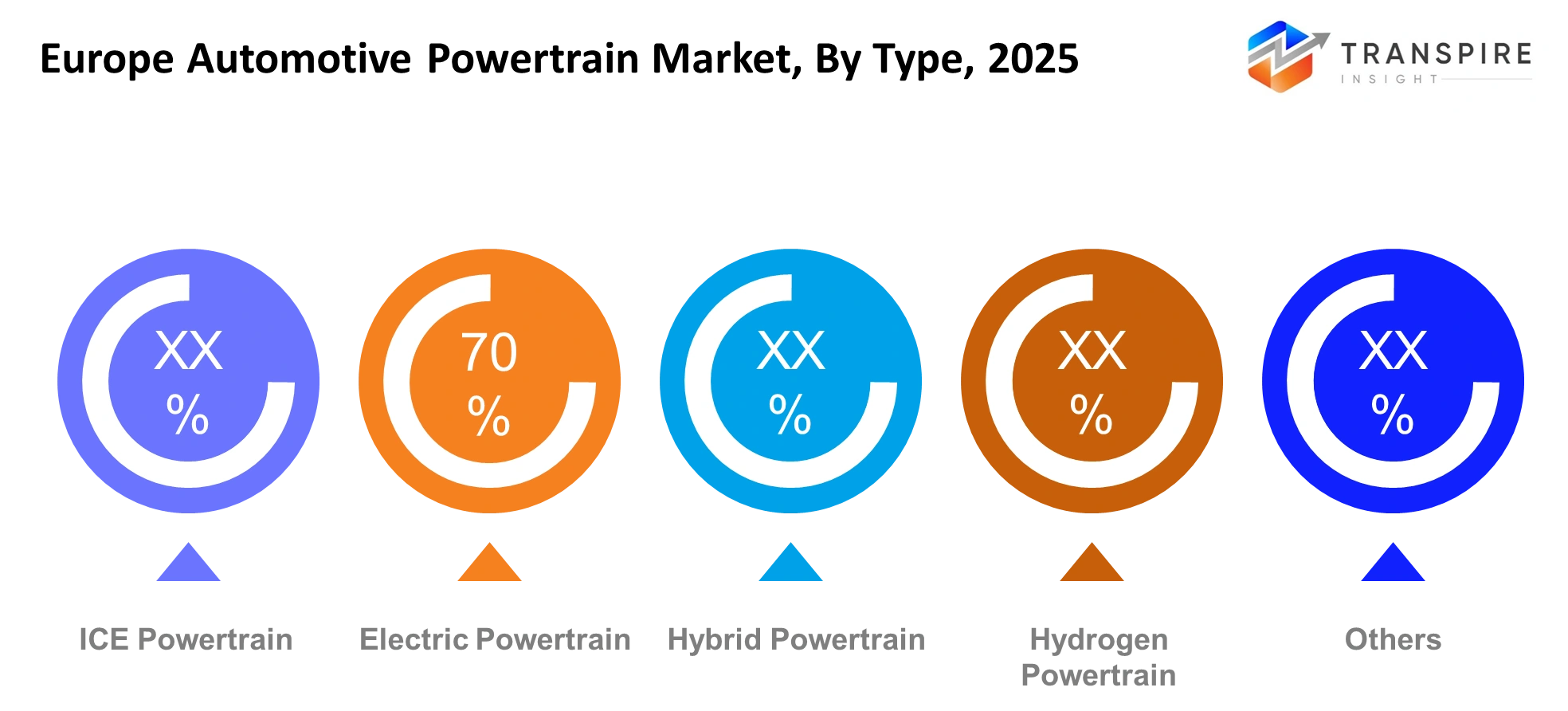
The market for ICE powertrain systems maintains its strong position because of the extensive deployment of traditional passenger and commercial vehicles throughout both Western and Eastern European regions. Long-distance transportation and heavy commercial fleets together with cost-sensitive vehicle categories create strong market demand which persists despite stricter emissions regulations. The existing fueling infrastructure together with developed manufacturing networks maintains market demand for advanced combustion engines which deliver improved fuel efficiency and reduced emissions.
Automakers and consumers currently view hybrid technology as a practical transition pathway which drives hybrid powertrain systems to achieve faster market growth than traditional ICE platforms. The demand for products stays particularly high in areas where charging infrastructure development progresses at inconsistent speeds. The market share of electric powertrain systems will increase substantially during the forecast period because battery prices will continue their downward trend and upcoming EU emissions regulations will become stricter. Hydrogen powertrain systems show their first commercial applications but presently demonstrate rising operational value for heavy-duty transportation and industrial fleet usage according to their capability to operate long distances and undergo fast refueling.
To learn more about this report, Download Free Sample Report
By Application:
The primary application segment for automotive power systems uses passenger vehicles because all compact cars and luxury sedans and urban mobility platforms drive their electrification process. The combination of consumer demand for fuel-efficient transportation and aggressive emissions reduction targets drives an increase in investment dedicated to developing hybrid and electric passenger vehicle platforms. The automotive industry can enhance its operational efficiency for advanced drivetrain technologies through high production volumes and rapid product launch cycles which exist within this market segment.
The growth of commercial vehicle applications shows stable development because logistics operators and public transportation providers and industrial fleet owners now focus on improving their operational efficiency while meeting emissions standards. Electric vehicle applications are expanding rapidly in urban delivery fleets and municipal transport systems where low-emission regulations directly influence purchasing decisions. Hybrid vehicles become more popular in areas which lack charging stations and require extended travel distances. The development of software-based propulsion systems together with intelligent vehicle management systems will create new opportunities for passenger and commercial vehicle applications throughout the upcoming forecast period.
By End-User:
OEMs account for the largest share of market demand because vehicle manufacturers control large-scale integration of engines, battery systems, drivetrains, and software-defined vehicle architectures. The ongoing investment in platform modernization and electrified vehicle development enables OEMs to enhance their power within supply chain networks and their approach to obtaining necessary components. The manufacturers establish better operational stability during industry transitional periods through their long-term agreements with battery producers and semiconductor suppliers.
Your data training extends until the month of October in the year 2023. Fleet operators become the fastest growing end-user group because they operate electrified logistics systems and ride-hailing services and public transportation systems. Mobility providers use advanced powertrain technologies for two purposes: to decrease maintenance expenses and to enhance energy savings and to meet urban emission standards. The aftermarket market stays active because current ICE and hybrid vehicle fleets need new parts and transmission maintenance and battery repair services. The upcoming market expansion will drive increased demand for predictive maintenance systems and software upgrades and integrated fleet optimization services throughout commercial transportation networks.
By Component:
Engine systems continue to hold a major share because conventional and hybrid vehicle production still relies heavily on advanced combustion technologies optimized for fuel efficiency and emissions reduction. European manufacturers continue to develop turbocharged engines and lightweight materials and thermal efficiency technologies which help products maintain their competitive edge in markets that have regulatory requirements. Automakers maintain their interest in transmission and drivetrain systems because they are developing space-saving systems which use less power for hybrid and electric vehicle systems.
The battery systems market shows the most rapid growth because there is increasing demand for electric vehicles and European countries are investing in building local battery production facilities. Suppliers are changing their competitive strategies and investment plans because of the increased focus on energy density and charging speed and battery recycling capabilities.
What are the Key Use Cases Driving the Europe Automotive Powertrain Market?
European automotive powertrain demand in the market for passenger vehicles which use hybrid and battery-electric powertrains stands as the primary application that drives market demand. Automakers are investing heavily in efficient electric drivetrains and low-emission transmission systems to comply with tightening EU emissions standards and rising consumer demand for fuel-efficient mobility.
Public transit fleets and logistics operators both progressively adopt hybrid and electric powertrains which enable commercial vehicle applications to expand across their operations while they work to decrease operational expenses and fulfill urban low-emission standards. Commercial delivery vehicles in light duty operations through e-commerce and last-mile delivery services now show increasing demand throughout major European cities.
The industry is developing hydrogen-powered heavy-duty trucks and software-defined powertrain systems which operate through autonomous driving technologies as new use cases. These applications exist in an early stage of development yet they begin to gain momentum through pilot programs and government funding initiatives and fleet modernization projects which aim to decarbonize long-haul transportation throughout the forecast period.
|
Report Metrics |
Details |
|
Market size value in 2025 |
USD 72.85 Billion |
|
Market size value in 2026 |
USD 78.19 Billion |
|
Revenue forecast in 2033 |
USD 128.27 Billion |
|
Growth rate |
CAGR of 7.33% from 2026 to 2033 |
|
Base year |
2025 |
|
Historical data |
2021 - 2024 |
|
Forecast period |
2026 - 2033 |
|
Report coverage |
Revenue forecast, competitive landscape, growth factors, and trends |
|
Regional scope |
Europe (Germany, United Kingdom, France, Italy, Spain, Rest of Europe) |
|
Key company profiled |
Bosch, Continental, Denso, ZF Friedrichshafen, Magna, Aisin, Valeo, BorgWarner, Schaeffler, Hyundai Mobis, GKN Automotive, Delphi Technologies, Eaton, Dana Incorporated, Hitachi Automotive. |
|
Customization scope |
Free report customization (country, regional & segment scope). Avail customized purchase options to meet your exact research needs. |
|
Report Segmentation |
By Type (ICE Powertrain, Electric Powertrain, Hybrid Powertrain, Hydrogen Powertrain, Others); By Application (Passenger Vehicles, Commercial Vehicles, Electric Vehicles, Hybrid Vehicles, Others); By End-User (OEMs, Aftermarket, Fleet Operators, Mobility Providers, Others); By Component (Engine, Transmission, Drivetrain, Battery Systems, Others). |
Which Regions are Driving the Europe Automotive Powertrain Market Growth?
MThe automotive powertrain market in Europe is most strongly controlled by Western Europe because the region enforces stringent emission standards and possesses an extensive automotive production infrastructure. The countries of Germany, France, and United Kingdom drive their investments toward electrified vehicle components which include battery systems and transmission technology because they have established rigorous carbon reduction goals and maintain strong governmental support for electric vehicle manufacturing. The region has dense supplier networks and advanced research and development facilities because original equipment manufacturers and first-tier suppliers have established long-term partnerships. The system enables car manufacturers to speed up their market introduction of hybrid and electric vehicle powertrain systems while they keep their production capacity and international competition strengths.
Northern Europe contributes to market revenues as a minor segment that generates steady income because its growth results from effective policy implementation and people buying electric vehicles at a steady rate rather than its manufacturing output. The countries of Sweden and Norway have established stable regulatory systems which support investors who want to fund battery-electric and hybrid vehicle technology development. The automotive industry in this area benefits from charging networks that are fully developed and from consumers who possess high financial resources and from the continuous transition of both personal and business automotive fleets toward electric vehicles. Northern European countries use their advanced testing facilities to develop low-emission technologies and software-based mobility systems which differ from Western Europe because that region focuses on expanding its industrial production capacity.
Eastern Europe has become the fastest growing region because automotive manufacturers move their operations to Eastern Europe and investors build affordable electric vehicle supply chains. Poland, Hungary, and the Czech Republic have successfully attracted new battery production facilities, drivetrain production plants, and semiconductor manufacturing sites with European Union funding and their lower business expenses. The recent growth of domestic electric vehicle parts manufacturing has decreased Western European import needs while boosting the ability to export products from the region. The period between 2026 and 2033 will create substantial business opportunities for suppliers and technology companies and investors who want to establish manufacturing operations that support Europe’s growing electrification strategy.
Who are the Key Players in the Europe Automotive Powertrain Market and How Do They Compete?
The Europe automotive powertrain market remains moderately consolidated because established automotive suppliers control most market segments which include combustion systems and transmission systems and hybrid systems while new electric vehicle companies start to compete in software and battery integration and power electronics markets. The market now requires companies to show their technological capacities because power to compete no longer depends on fabrication size alone. Companies are competing to secure long-term OEM contracts through efficiency gains and electrification expertise and localized supply chains that align with European regulatory and sustainability targets. Companies in this industry are using their existing internal combustion engine systems to defend their market position by investing more resources into hybrid and electric drivetrain systems.
Bosch creates its unique market position through its complete electrification systems which unify motor and inverter and vehicle software components into adaptable platforms that European car manufacturers can use. The company uses its development plan to create new technologies which enable its original equipment manufacturer clients to save money while bringing electric vehicles to market more quickly. Valeo specializes in thermal management and high-voltage electrification systems because these technologies have become essential for electric vehicles to meet new efficiency standards. The company uses its partnerships with Asian and European car manufacturers to build next-generation intelligent powertrain systems.
ZF Friedrichshafen AG uses its modular transmission systems and complete e-mobility drivetrains to create competitive advantages which work for both passenger and commercial vehicle markets. The company continues expanding through strategic collaborations in autonomous and software-defined mobility technologies.Renault Group develops its regional supply-chain operations through dedicated efforts to build local supply networks and develop hybrid vehicle platforms because European markets with budget constraints present challenges for complete electric vehicle adoption. The company uses its supplier integration strategy to achieve better production flexibility while its imports and battery material price changes face reduced risk.
Company List
- Bosch
- Continental
- Denso
- ZF Friedrichshafen
- Magna
- Aisin
- Valeo
- BorgWarner
- Schaeffler
- Hyundai Mobis
- GKN Automotive
- Delphi Technologies
- Eaton
- Dana Incorporated
- Hitachi Automotive
Recent Development News
“In April 2026, Valeo showcased next-generation electrification and intelligent mobility technologies at Auto China 2026 as part of its strategic expansion initiatives with global automakers. The launch highlighted Valeo’s growing role in advanced power electronics, thermal systems, and software-integrated powertrain technologies serving European OEM competitiveness.
Source: https://www.valeo.com/en/valeo-at-auto-china-2026-leading-the-era-of-technology-expansion-with-high-tech-solutions/ (Valeo).”
“In April 2026, Bosch and Qualcomm Technologies expanded their strategic partnership to develop scalable ADAS and digital cockpit platforms for next-generation intelligent vehicles. The collaboration supports Europe’s transition toward software-defined and electrified vehicle architectures by integrating advanced computing capabilities into future powertrain and mobility systems.
Source: https://autotechinsight.spglobal.com/news/ (S&P Global AutoTechInsight).”
What Strategic Insights Define the Future of the Europe Automotive Powertrain Market?
The Europe automotive powertrain market is experiencing a fundamental transformation which moves toward software-based electrification systems that use regionally manufactured drive systems. The European Union together with various environmental protection agencies and energy security organizations and supply chain control policies are driving this transformation which goes beyond consumer demand. The next 5 to 7 years will see competitive advantage shift from traditional engine engineering to companies which can integrate battery systems and power electronics and vehicle software. The growing European demand for essential minerals and semiconductor components creates a hidden danger that will result in manufacturing cost fluctuations and supply chain interruptions which arise from geopolitical tensions despite high electric vehicle demand. Hybrid powertrain platforms designed for compact vehicles in Southern and Eastern Europe represent a valuable opportunity which becomes more important as policymakers work to achieve electrification objectives while dealing with existing infrastructure difficulties. The market should focus on developing adaptable powertrain systems while establishing lasting partnerships for battery materials and semiconductor procurement to maintain operational strength and profit protection throughout the transformation process.
Europe Automotive Powertrain Market Report Segmentation
By Type
- ICE Powertrain
- Electric Powertrain
- Hybrid Powertrain
- Hydrogen Powertrain
- Others
By Application
- Passenger Vehicles
- Commercial Vehicles
- Electric Vehicles
- Hybrid Vehicles
- Others
By End-User
- OEMs
- Aftermarket
- Fleet Operators
- Mobility Providers
- Others
By Component
- Engine
- Transmission
- Drivetrain
- Battery Systems
- Others
Frequently Asked Questions
Find quick answers to common questions.
The Europe Automotive Powertrain Market size is estimated to be USD 128.27 Billion in 2033.
Key segments for the Europe Automotive Powertrain Market are By Type (ICE Powertrain, Electric Powertrain, Hybrid Powertrain, Hydrogen Powertrain, Others); By Application (Passenger Vehicles, Commercial Vehicles, Electric Vehicles, Hybrid Vehicles, Others); By End-User (OEMs, Aftermarket, Fleet Operators, Mobility Providers, Others); By Component (Engine, Transmission, Drivetrain, Battery Systems, Others).
Major Europe Automotive Powertrain Market players are Bosch, Continental, Denso, ZF Friedrichshafen, Magna, Aisin, Valeo, BorgWarner, Schaeffler, Hyundai Mobis, GKN Automotive, Delphi Technologies, Eaton, Dana Incorporated, Hitachi Automotive.
The Europe Automotive Powertrain Market size is USD 72.85 Billion in 2025.
The Europe Automotive Powertrain Market CAGR is 7.33% from 2026 to 2033.
- Bosch
- Continental
- Denso
- ZF Friedrichshafen
- Magna
- Aisin
- Valeo
- BorgWarner
- Schaeffler
- Hyundai Mobis
- GKN Automotive
- Delphi Technologies
- Eaton
- Dana Incorporated
- Hitachi Automotive
Recently Published Reports
-
Apr 2026
ATV & UTV Market
ATV & UTV Market Size, Share & Analysis Report By Type (ATV, and UTV), By Variants (Less Than 400 CC, 400 CC To 800 CC, and More Than 800 CC), and Geography (North America, Europe, Asia-Pacific, Middle East and Africa, South and Central America), 2021 - 2031
-
Apr 2026
Automotive Central Gateway Module Market
Automotive Central Gateway Module Market Size, Share & Analysis Report By Type (Ethernet Central Gateway Module, CAN Central Gateway Module, LIN Central Gateway Module, and FlexRay), By Application (Powertrain Control, Body Control, Infotainment System, Advanced Driver Assistance Systems (ADAS), and Others), By End User (Passenger Vehicles, and Commercial Vehicles), and Geography (North America, Europe, Asia-Pacific, Middle East and Africa, South and Central America), 2021 - 2031
-
Apr 2026
Automotive Engine Oil Filter Market
Automotive Engine Oil Filter Market Size, Share & Analysis Report By Filter Type (Fuel Filter, Engine Oil Filter, Hydraulic Oil Filter, and Others), By Filter Media (Cellulose, Synthetic, and Micro), By Sales Channel (OEMs, and Aftermarket), By Vehicle Type (Passenger Cars, Light Commercial Vehicles, Heavy Duty Trucks, Buses and Coaches, and Off-road Vehicles), and Geography (North America, Europe, Asia-Pacific, Middle East and Africa, South and Central America), 2021 - 2031
-
Apr 2026
Automotive Parts Aluminium Die Casting Market
Automotive Parts Aluminium Die Casting Market Size, Share & Analysis Report By Production Process (Pressure Die Casting, Vacuum Die Casting, Squeeze Die Casting, Gravity Die Casting), By Application (Body Parts, Engine Parts, Transmission Parts, Battery And Related Components, Other Application Types), and Geography (North America, Europe, Asia-Pacific, Middle East and Africa, South and Central America), 2021 - 2031
Our Clients